• Photo by Rantje Allen

  • Photo by William Tan

  • Photo by Rantje Allen

  • Photo by William Tan

  • Photo by Rantje Allen

Loading content - please wait...

Yearly Archives: 2026

Twinspot Cardinalfish find shelter

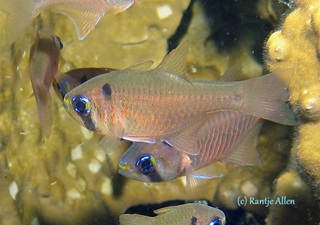
Twinspot Cardinalfish find shelter during daylight hours. They hover in small groups among dense hard corals.

Identifying the Twinspot Cardinalfish

The Twinspot Cardinalfish gets its scientific name from two dark spots on its body. That name is Taeniamia biguttata. One spot is behind the head. The second spot is on the mid-tail base. The fish seems to darken or lighten its tail spot. Also, this cardinalfish has a dark bar below the eye. This dark bar distinguishes this species from others at times when the second spot on the tail is diffuse. These features help separate it from similar species.

Twinspot cardinalfish
Twinspot cardinalfish hide among corals

As with many cardinalfish, the Twinspot’s body is pale and slightly transparent. Rows of narrow orange bars decorate it. And tiny dashes of bright yellow mark the mouth and eyes. Most remarkable in the Twinspot Cardinalfish found in Gorontalo are the electric blue markings on its eyes. This striking feature does not appear in other photographs of Taeniamia biguttata. Fishes of Gorontalo often appear more colorful than the same species found elsewhere.

Sheltering in Gorontalo’s hard corals

Schools of Twinspot Cardinalfish typically shelter among dense branching corals during the day. Only careful divers will notice them. Usually, they hover in place. They will only move when approached. Often, they will move as a school. Notice this behavior in our video.

Still photographs taken of these Twinspot Cardinalfish were carefully animated using AI. Notice which individual fish display the tail spot and which do not. Several other cardinalfish of different species have joined these schools.

Behavior & Feeding

Cardinalfish species rely on the group for safety. By staying close together, they reduce the chance of being eaten by predators. Their pale color also helps them blend into the background.

If disturbed, the group will move deeper into cover. They do not swim fast over long distances. Instead, they depend on hiding.

Twinspot Cardinalfish are active at night. In darkness, they leave their shelter to feed on plankton in the water. The eyes are large, which helps the fish see in low light. Most individuals are only a few centimeters long.

This species is found across the Indo-Pacific from Indonesia’s Sumatra to Japan. It prefers protected reef areas, especially places with overhangs or branching coral. Groups can be small or quite dense.

If you would like one of our dive masters to point out cardinalfish, please let him know. For bookings, please contact us.

Bigfin reef squid mating dance

Bigfin Reef Squid are a fascinating sight for divers in Gorontalo. Often, small groups of these squid hover in open water above the reef slope.

Mating Dance Captured on Video

During courtship, their bodies shimmer with changing colors and patterns. Only the luckiest of divers witness this remarkable mating dance of flashing colors and synchronized movement. Ted Foon, one of our guests, captured several minutes of this rarely witnessed behavior. We share highlights in our YouTube video.

Identifying Bigfin Reef Squid

The squid in this video is the Bigfin Reef Squid. Its scientific name is Sepioteuthis lessoniana. Its large oval fins make it easy to recognize. They run almost the entire length of the mantle. These fins give the squid a shape that resembles a cuttlefish. The body is semi-transparent. But it can flash brilliant stripes or waves of color. Scientists believe that these color changes help squid communicate during courtship and competition.

Bigfin Reef Squid typically grow to about 30 centimeters in length. They are common throughout the Indo-Pacific. Often in small groups, these squid gather in shallow water near coral reefs, seagrass beds, or mooring lines. During mating displays, males may guard a female while rival males attempt to approach. The rapid changes of color and pattern are part of this visual communication. However, in our video, no other males were present.

Conservation & Natural Observation

Reef squid are important predators in coral reef ecosystems. They feed on small fish, shrimp, and other crustaceans. In turn, they are prey for larger fish, dolphins, and other marine animals.

bigfin reef squid
Bigfin reef squid mating

Encounters with Bigfin Reef Squid are most memorable when divers remain patient and respectful. When divers maintain a distance and move calmly, the squid can continue their graceful courtship displays. These moments reveal the remarkable intelligence and beauty of reef cephalopods in their natural environment.

Squid are highly intelligent and show awareness of divers. If a diver spots a group of them, the squid will retreat by swimming backwards until they disappear from sight.

For your chance to see squid hovering over Gorontalo reefs, make your dive booking directly with us.

Hawksbill sea turtle observed naturally

Hawksbill sea turtles are a common sight for divers in Gorontalo. In our video, one sea turtle feeds under coral, scratches beneath its flipper, and swims to the surface to breathe. Because the divers stayed calm and kept their distance, the turtle acted naturally. It did not flee or show stress. Respectful diving allows turtles to behave as they would without humans nearby.

Responsible Diver Behavior

Good diver etiquette is key. Divers must maintain good buoyancy, avoid sudden movements, and never block a turtle’s path to the surface. Also, divers must never surround a turtle, lest it fear being attached. Moreover, chasing or touching a turtle can stress it and disrupt normal behaviors like feeding or breathing. Patience and calm observation let divers see authentic marine life in action. In our video, the turtle ignored the divers because they followed these guidelines.

When photographing a sea turtle, approach only as close as the turtle allows. In our video, our dive master used a long selfie stick. Also, we used a zoom feature when editing to get super close-up shots.

Identifying the Hawksbill Sea Turtle

hawksbill sea turtle
A Hawksbill sea turtle watches divers

The sea turtle in this video is a Hawksbill. Its scientific name is Eretmochelys imbricata. It has a hooked beak and two pairs of small scales between its eyes. These four scales are clearly visible when the turtle looks directly into the camera. The overlapping shell plates give the rear edge a jagged look. Each front flipper has two visible claws. Hawksbills in the Indo-Pacific grow to about one meter long and take decades to reach maturity.

Hawksbills feed mainly on sponges but also eat tunicates, soft corals, jellyfish, crabs, squid, and small fish. In the video, the turtle searched carefully under coral for food. Its slow, deliberate movements show it was comfortable and undisturbed by divers.

Conservation Status

Eretmochelys imbricata is critically endangered. It is illegal to harm, capture, or trade Hawksbill sea turtles or their shells. Plastic pollution is a major threat because turtles may mistake bags for jellyfish. Observing turtles responsibly helps them conserve energy and continue natural behaviors.

Hawksbill encounters are best when patience and respect guide the dive. When divers follow proper etiquette, turtles can feed and move freely without disturbance. To see a Hawksbill sea turtle behaving naturally on Gorontalo reefs, make your dive booking directly with us.

Grand Side-Gilled Slug Takes a Day Trip

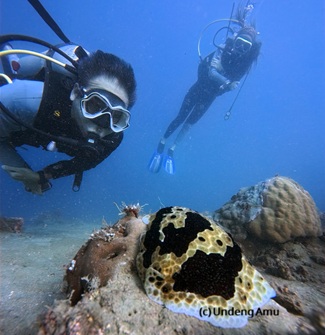
As large as a dinner plate, the Grand side-gilled slug delights divers during night dives. But during the last day of 2025, one crawled across the bottom in daylight.

A Nocturnal, Giant Sea Slug

Most divers are familiar with nudibranchs. They have feathery gills exposed on the top of their bodies. Side-gilled sea slugs are different. Their large, plume-like gills hide between the mantle and the foot. They are usually tucked along the right side of the body. This unique arrangement gives the group its common name.

Grand Side-Gilled Slug
Surprising daylight sighting

Grand side-gilled sea slugs live primarily on shallow sand and rubble bottoms. They are almost exclusively nocturnal. This behavior makes them ideal targets for sightings during night dives. After dark, they crawl across the sea floor, actively hunting tunicates, anemones, and other invertebrates. With strong jaws and a wide mouth, this species can even consume sleeping fish.

Like other members of this group, the Grand side-gilled slug has a pair of rolled rhinophores. These detect chemical cues and water movement, helping to locate prey in the absence of light. When threatened, it can secrete sulfuric acid as a chemical defense. As a result, most predators avoid this giant slug.

The Grand Side-Gilled Slug

The Grand side-gilled slug is the most commonly seen species of its kind in Gorontalo. It can grow to an astonishing 21 centimeters. It may be the largest sea slug divers are likely to encounter. Its scientific name is Pleurobranchus grandis.

Its coloration varies widely. However, the species usually displays three dark bands that contrast sharply with the rest of its body. When moving, the slug can arch its mantle, forming a raised spout toward the rear. This structure helps channel water and waste away from the body as it travels across the seabed.

Despite its size, P. grandis moves deliberately and calmly. Notice its subtle movements in our video.

Surprising Sighting in Gorontalo

Imagine our surprise and delight at finding a Grand side-gilled slug crawling in broad daylight. Fortunately, one of our dive masters had an underwater camera ready to capture this moment. Given that the date was December 31st, we speculated that it was on its way to a New Year’s Eve party.

For your chance to make an unexpected encounter in Gorontalo, make a booking with us.

mgd-logo-block