
Loading content - please wait...
Tergiposacca longicerata discovered in Gorontalo
Tergiposacca longicerata is a newly described species of nudibranch, named in 2016. It is unusual in body composition and lays distinctive clusters of eggs.
Distinctive Appearance
This tiny aeolid nudibranch usually measures only a few millimeters in length. But some measure up to 15 mm. Its most distinctive feature is finger-like projections on its back. These are called cerata. On Tergiposacca longicerata, they are very long, thin, and cylindrical. They start behind the head and reach almost to the tail. Their shape is like match sticks.
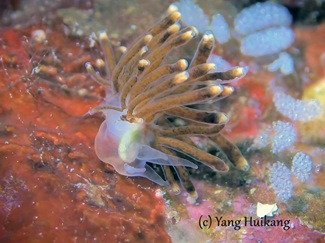
Also unusual is its red-orange-colored jaw, which is visible through its transparent body. This nudibranch can exhibit some body coloration. The light coloration can be orange, yellow, gray, or burgundy. This color comes from internal organs visible through the transparent body.
Note the yellowish internal organs near the head in the photographs from Gorontalo. Also notice that the brownish cerata appear enveloped in whitish, translucent skin. This is distinctive of Tergiposacca longicerata.
The Naming of Tergiposacca longicerata
In 2016, Kristen Cella and colleagues published a major phylogenetic study. Its title was A Radical Solution: The Phylogeny of the Nudibranch Family Fionidae. They used DNA analysis to determine that the rare and tiny nudibranch in question was distinctly different both in body and DNA from other aeolid nudibranchs. Because of the long cerata, they named it Tergiposacca longicerata.
Besides the unusual cerata and reddish jaws, this nudibranch also lays distinctive egg masses. These look like bunches of white grapes and are called saccate. This characteristic made its way into the new genus name.
Note in the photograph from Gorontalo the white egg clusters in the background. On this day of discovery, our dive master found about a dozen of this nudibranch species. They were close together and laying eggs.
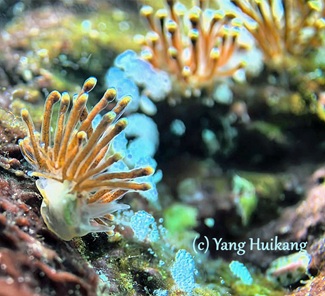
Stealer of Stings
The tips of the cerata contain cnidosacs that store nematocysts from stinging hydroids. This nudibranch eats a mixed diet that includes hydroids.
However, the stinging parts are not digested. Instead, they are transported internally to the tips of the cerata into tiny sacs. If something molests this nudibranch, those stinging cells are released in defense.
First Sighting in Gorontalo
In the original research paper, scientists cited discoveries of Tergiposacca longicerata in the Philippines, Papua New Guinea, and southern Japan. Records expanded to Singapore, Indonesia, and the Marshall Islands.
Typically, this newly named nudibranch is found in shallow water, about two to five meters in depth. Those from Gorontalo were about twelve meters in depth. Although found at the site that we dive each week, we had never before seen this unusual nudibranch in Gorontalo.
For your chance to see unusual marine life in Gorontalo, please contact us for your dive trip booking.