• Photo by Rantje Allen

  • Photo by William Tan

  • Photo by Rantje Allen

  • Photo by William Tan

  • Photo by Rantje Allen

Loading content - please wait...

Tag Archives: Gorontalo Diving

Bigfin reef squid mating dance

Bigfin Reef Squid are a fascinating sight for divers in Gorontalo. Often, small groups of these squid hover in open water above the reef slope.

Mating Dance Captured on Video

During courtship, their bodies shimmer with changing colors and patterns. Only the luckiest of divers witness this remarkable mating dance of flashing colors and synchronized movement. Ted Foon, one of our guests, captured several minutes of this rarely witnessed behavior. We share highlights in our YouTube video.

Identifying Bigfin Reef Squid

The squid in this video is the Bigfin Reef Squid. Its scientific name is Sepioteuthis lessoniana. Its large oval fins make it easy to recognize. They run almost the entire length of the mantle. These fins give the squid a shape that resembles a cuttlefish. The body is semi-transparent. But it can flash brilliant stripes or waves of color. Scientists believe that these color changes help squid communicate during courtship and competition.

Bigfin Reef Squid typically grow to about 30 centimeters in length. They are common throughout the Indo-Pacific. Often in small groups, these squid gather in shallow water near coral reefs, seagrass beds, or mooring lines. During mating displays, males may guard a female while rival males attempt to approach. The rapid changes of color and pattern are part of this visual communication. However, in our video, no other males were present.

Conservation & Natural Observation

Reef squid are important predators in coral reef ecosystems. They feed on small fish, shrimp, and other crustaceans. In turn, they are prey for larger fish, dolphins, and other marine animals.

bigfin reef squid
Bigfin reef squid mating

Encounters with Bigfin Reef Squid are most memorable when divers remain patient and respectful. When divers maintain a distance and move calmly, the squid can continue their graceful courtship displays. These moments reveal the remarkable intelligence and beauty of reef cephalopods in their natural environment.

Squid are highly intelligent and show awareness of divers. If a diver spots a group of them, the squid will retreat by swimming backwards until they disappear from sight.

For your chance to see squid hovering over Gorontalo reefs, make your dive booking directly with us.

Hawksbill sea turtle observed naturally

Hawksbill sea turtles are a common sight for divers in Gorontalo. In our video, one sea turtle feeds under coral, scratches beneath its flipper, and swims to the surface to breathe. Because the divers stayed calm and kept their distance, the turtle acted naturally. It did not flee or show stress. Respectful diving allows turtles to behave as they would without humans nearby.

Responsible Diver Behavior

Good diver etiquette is key. Divers must maintain good buoyancy, avoid sudden movements, and never block a turtle’s path to the surface. Also, divers must never surround a turtle, lest it fear being attached. Moreover, chasing or touching a turtle can stress it and disrupt normal behaviors like feeding or breathing. Patience and calm observation let divers see authentic marine life in action. In our video, the turtle ignored the divers because they followed these guidelines.

When photographing a sea turtle, approach only as close as the turtle allows. In our video, our dive master used a long selfie stick. Also, we used a zoom feature when editing to get super close-up shots.

Identifying the Hawksbill Sea Turtle

hawksbill sea turtle
A Hawksbill sea turtle watches divers

The sea turtle in this video is a Hawksbill. Its scientific name is Eretmochelys imbricata. It has a hooked beak and two pairs of small scales between its eyes. These four scales are clearly visible when the turtle looks directly into the camera. The overlapping shell plates give the rear edge a jagged look. Each front flipper has two visible claws. Hawksbills in the Indo-Pacific grow to about one meter long and take decades to reach maturity.

Hawksbills feed mainly on sponges but also eat tunicates, soft corals, jellyfish, crabs, squid, and small fish. In the video, the turtle searched carefully under coral for food. Its slow, deliberate movements show it was comfortable and undisturbed by divers.

Conservation Status

Eretmochelys imbricata is critically endangered. It is illegal to harm, capture, or trade Hawksbill sea turtles or their shells. Plastic pollution is a major threat because turtles may mistake bags for jellyfish. Observing turtles responsibly helps them conserve energy and continue natural behaviors.

Hawksbill encounters are best when patience and respect guide the dive. When divers follow proper etiquette, turtles can feed and move freely without disturbance. To see a Hawksbill sea turtle behaving naturally on Gorontalo reefs, make your dive booking directly with us.

Grand Side-Gilled Slug Takes a Day Trip

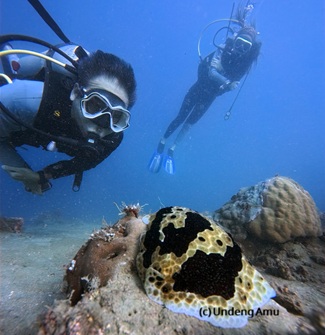
As large as a dinner plate, the Grand side-gilled slug delights divers during night dives. But during the last day of 2025, one crawled across the bottom in daylight.

A Nocturnal, Giant Sea Slug

Most divers are familiar with nudibranchs. They have feathery gills exposed on the top of their bodies. Side-gilled sea slugs are different. Their large, plume-like gills hide between the mantle and the foot. They are usually tucked along the right side of the body. This unique arrangement gives the group its common name.

Grand Side-Gilled Slug
Surprising daylight sighting

Grand side-gilled sea slugs live primarily on shallow sand and rubble bottoms. They are almost exclusively nocturnal. This behavior makes them ideal targets for sightings during night dives. After dark, they crawl across the sea floor, actively hunting tunicates, anemones, and other invertebrates. With strong jaws and a wide mouth, this species can even consume sleeping fish.

Like other members of this group, the Grand side-gilled slug has a pair of rolled rhinophores. These detect chemical cues and water movement, helping to locate prey in the absence of light. When threatened, it can secrete sulfuric acid as a chemical defense. As a result, most predators avoid this giant slug.

The Grand Side-Gilled Slug

The Grand side-gilled slug is the most commonly seen species of its kind in Gorontalo. It can grow to an astonishing 21 centimeters. It may be the largest sea slug divers are likely to encounter. Its scientific name is Pleurobranchus grandis.

Its coloration varies widely. However, the species usually displays three dark bands that contrast sharply with the rest of its body. When moving, the slug can arch its mantle, forming a raised spout toward the rear. This structure helps channel water and waste away from the body as it travels across the seabed.

Despite its size, P. grandis moves deliberately and calmly. Notice its subtle movements in our video.

Surprising Sighting in Gorontalo

Imagine our surprise and delight at finding a Grand side-gilled slug crawling in broad daylight. Fortunately, one of our dive masters had an underwater camera ready to capture this moment. Given that the date was December 31st, we speculated that it was on its way to a New Year’s Eve party.

For your chance to make an unexpected encounter in Gorontalo, make a booking with us.

Winged Pipefish juvenile emerges from hiding

Winged Pipefish are rarely seen. So, imagine our surprise to find a juvenile, complete with its distinctive wings!

Coming a Coral Wall

winged pipefish
Tiny Winged pipefish

Miguel’s Diving staff work diligently to discover the hidden secrets of Gorontalo’s coral-rich dive sites. The dense hard coral environment provides many places for rare marine life to hide. This makes them hard to find.

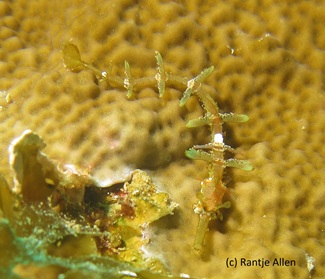
Yet one day, staff discovered a juvenile Winged Pipefish. It was hiding among clumps of Halimeda coralline algae. This green algae has flat, round discs. As they age and die, the green surface peels away, leaving a brilliant white skeleton. After being crushed by waves, it becomes white sand. Underwater, the contrast between dark green and bright white makes a perfect place for pipefish to hide.

Unfortunately, no macro photographers were on board on the day of discovery. So, the crew returned to the site the following day to make some photos and this video. Gorontalo’s direct sunlight made shooting quite a challenge since the Winged Pipefish floated out of dark corners to over-lit sand and algae patches.

Distinctives of Winged Pipefish

Its scientific name is Halicampus macrorhynchus because of its long nose. Other common names include Ornate or Whiskered Pipefish.

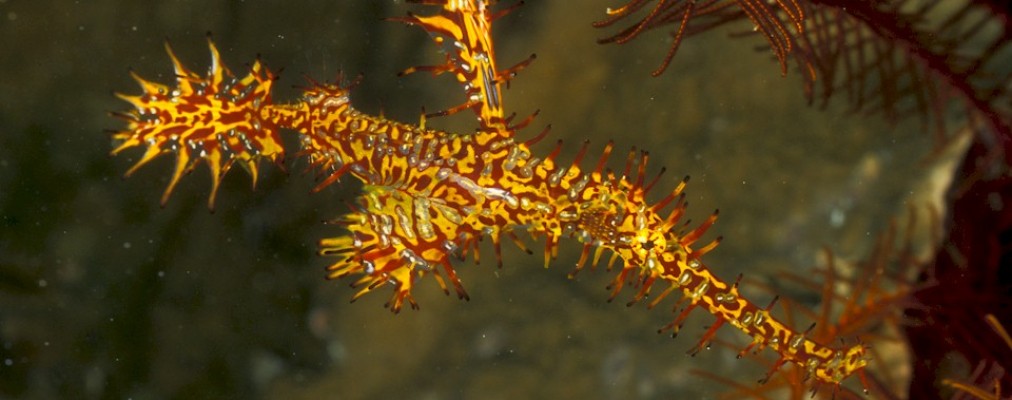
One main distinctive is fleshy growths on its body. Notice the eight to ten pairs of skin flaps along the body. As the pipefish matures, these begin to disappear. Also, its long nose and face have these growths. In fact, these growths can make the face hard to see. The body color varies greatly but usually shows white spots along its back.

Like other pipefish and seahorses, the Winged Pipefish male will brood eggs in a ventral pouch. Divers report seeing this species in Bali, Sulawesi, and Raja Ampat.

For your chance to make memories in Gorontalo, please make your dive reservations directly with Miguel’s Diving.  

Pinktail Triggerfish & its Coral Hideout

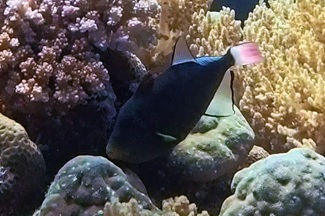
Pinktail Triggerfish, stylish and sleek, delight divers lucky enough to see even one, especially fans of pink. Although only occasionally found in Gorontalo, its coloration is bright and distinctive.

In the Pink

pinktail triggerfish
A uniquely pink tail

This fish’s body color is dark, from olive-brown to almost black. This helps the fish blend into the shadows of the coral reef. However, its active tail is magenta/pink with a distinct white base where the tail joins the dark body. Its elegantly paired dorsal and anal fins are ghostly white and edged in black. Yellowish are its pectoral fins and snout.

Many fish species can lighten and darken their body colors. If a Pinktail Triggerfish is in lighter mode, a crosshatch pattern appears on its body.

Its official name is Melichthys vidua. The genus name means “black fish” in Greek.

Active & Shy

Divers will find this fish both active and shy. Only when a Pinktail Triggerfish is hunting for food will it allow a closer approach. This fish eats mainly algae and detritus. However, using its dental plates, it can also eat crustaceans, octopuses, sponges, and even small fishes.

Locking a Trigger

The Pinktail Triggerfish has a locking mechanism in its dorsal fin spines. This body feature is unique to all triggerfish species. The fish can erect its first dorsal spine and lock it upright using its second spine. In order to unlock its trigger, the fish must first depress the second spine, allowing the first one to relax.

Triggerfish that feel threatened quickly jump into a hole or crevasse in the reef. By locking the trigger, it is wedged in and cannot be pulled out. The predator can only nip the edges of its unprotected tail while the fish hides.

Where to Find Pinktail Triggerfish

This delightful fish lives through Indo-Pacific region, including Tomini Bay where Miguel’s Diving offers scuba diving. Although this fish can gather in schools in other ocean locations, we only see it singly in Gorontalo.

Divers here will most likely see it in very shallow waters on coral rich dive sites where ocean currents sweep by. In other places, scientists have found it below fifty meters.

Since divers are unlikely to spot a Pinktail Triggerfish unaided, ask one of our dive masters to point one out during your diving day.

For your chance to make memories in Gorontalo, please make your dive reservations directly with Miguel’s Diving.  

The Black-Blotched Porcupinefish: Spiny, Shy & Striking

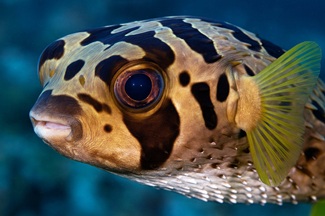
A most unusual fish divers see while diving in Gorontalo is the Black-Blotched Porcupinefish. Most noticeable are its large head and big eyes. Short, strong spines stick out from the back half of its body.

Striking patterns of the Black-Blotched Porcupinefish

Divers can easily recognize a Black-Blotched Porcupinefish. In the video shot while diving Gorontalo, notice its large size. Also striking are the broken dark bars on its face and head. Note the big black blotches on its back and sides. Its fins are yellow. Standing out against its grayish brown body are its white spines.

The scientific name for this fish is Diodon liturosus.

Fish Habits

This fish often hides under rocks or swims slowly along coral reefs. Its large eyes help it while hunting at night. Crustaceans and mollusks compose its main meal. The fish’s beak-like teeth crush the hard shells of these invertebrates. Notice in our video that the fish searches the sandy bottom for something to eat.

A Ball of Spines

When a Black-Blotched Porcupinefish feels in danger, it has a special way to protect itself. It quickly gulps water and swells. This makes its spines stick out. The fish becomes a ball with sharp spines. As a result, predators do not want to eat a fish like that. This defense is common in porcupinefish species.

Divers might see two other porcupinefish species. One is the Spot-Fin Porcupinefish (Diodon hystrix). It has many small black spots all over its body and fins. However, it lacks dark blotches or bars on the face. The second is the Long-Spine Porcupinefish (Diodon holocanthus). A net-like pattern covers its body. Although it has big eyes, it lacks the large blotches of the Black-Blotched Porcupinefish. Also, the spines are longer and thinner.

Black-Blotched Porcupinefish
A young Black-spotted porcupinefish AI

Good Behavior for Divers

Even though porcupinefish look friendly, divers should approach with caution. Do not chase or touch them. Never try to make one inflate. This stresses the fish since it thinks you want to eat it. At Miguel’s Diving, we believe in safe and respectful diving.

Porcupinefish also contain tetrodotoxin. This is a potent neurotoxin that makes them unpalatable or deadly to most predators and humans.

Since this fish is rarely encountered, seeing a Black-Blotched Porcupinefish during your dive will make a special memory.

For your chance to make memories in Gorontalo, please make your dive reservations directly with Miguel’s Diving.  

Location of Miguel’s Diving Gorontalo

Location is key for any business, including Miguel’s Diving. Less than an hour from Gorontalo’s airport, our dive center rests in a safe location inside the Bone River. This provides direct access to the vast Tomini Bay.

Our Airport Code: GTO

Daily, direct flights from Jakarta land at Gorontalo’s Jalaluddin Airport. It is modern and spacious. Our package options include airport transfers. Upon exiting baggage claim, divers simply look for a driver holding a paper with their names on it. The ride into town is less than an hour.

location of Miguel's Diving
Our Google Earth location

One option we offer is diving upon arrival. This is possible for passengers of Batik Air whose flight arrives here at about 8 a.m. Prior arrangement is required.

Google Map Location

Finding us on Google Maps is easy. Just type in Miguel’s Diving Gorontalo in the search bar. This is our location link.

However, this location is about five meters off, which is within the error margin for Google Maps. Travelers can be confused when they arrive at a block ice factory used by fishermen! Google still has a picture of this blue factory for its street photo of Miguel’s Diving. Actually, we are the two-story yellow building next door. A huge dive flag is painted on the street-facing side of our dive center. Slide the gate open and enter.

To help travelers visualize our location, we have created a short video that starts in space and zooms all the way into our dive center in Gorontalo. It includes satellite animation using Google Earth, plus drone footage of our dock, dive boats, and the expansive blue waters we explore daily during dive season.

Strategic Dock Location

Our dive center and dock are located just inside the estuary of Bone River. The name is pronounced boh-nay. This gives our divers a clean, secure area to organize gear prior to diving. They can also relax there after the dive day.

Travelers may question why we do not anchor our boats along the ocean. Because of Gorontalo’s unique geography and rapidly changing weather, that option is not wise.

Also, we guard our speed boats round-the-clock against sudden storms and waves. Over our two decades of operation, our strategic location and dedicated staff have prevented our boats from damage or sinking.

Miguel’s Diving is located along the northern coast of Tomini Bay in Sulawesi, Indonesia. This bay is one of the deepest in the world and offers pristine diving conditions and rare marine life—like our iconic Salvador Dali sponges.

To assist in your dive trip planning, please make your dive reservations directly with Miguel’s Diving. 


Thysanozoon nigropapillosum Swims & Dazzles

Thysanozoon nigropapillosum is a dazzling flatworm. Yellow- or gold-tipped papillae cover its black body. Its body margin has bold white edges.

Many Confusing Names

Thysanozoon nigropapillosum
Thysanozoon nigropapillosum at Mirabella dive site

Thysanozoon nigropapillosum lacks a standard English name. Some call it the Yellowspotted, Yellow-spotted, Yellow Spot, or Yellow-speckled Flatworm. Others refer to the spots as gold. Some online sources call it the Galaxy Flatworm since its body looks like a maze of stars.

Appearances of Thysanozoon nigropapillosum in Gorontalo

Before opening diving in Gorontalo, Miguel’s Diving surveyed potential dive spots. In May 2000, we recorded our first sighting of Thysanozoon nigropapillosum off the coast of Bone Pantai Regency. Since then, we have rarely encountered this beautiful flatworm—perhaps only once every five years!

In 2025, one of our guests captured Thysanozoon nigropapillosum on video, creating an intriguing clip. Flatworms can swim short distances by waving their flat bodies. The video shot by Rainer de Reuter captures this undulating motion perfectly!

Notice the two white-tipped protrusions at the front of the flatworm. These are pseudotentacles. They sense light and motion, helping the flatworm navigate.

Favorite Food

Didemnum molle
Molle tunicates

Thysanozoon nigropapillosum feeds on certain species of tunicates. One of its favorites is Didemnum molle, which is very common in Gorontalo. The flatworm engulfs the tunicate’s thin body with its mouth. However, it does not digest the hard calcium spicules that give the tunicate structure. Instead, these are expelled as pellets.

Savage Mating

All flatworms are hermaphrodites, meaning they have both male and female reproductive organs. Thysanozoon nigropapillosum also has two penises. During mating, each flatworm attempts to inseminate the other. First, special structures called rhabdites grip the partner’s edge, providing a strong hold even while swimming. Then, the two try to stab each other with a penis—or both! The maze of yellow papillae makes aiming difficult, and missed attempts often result in dermal impregnation.

Where to Find this Dazzling Flatworm

Found throughout Indo-Pacific waters, this dazzling flatworm can grow up to 8 centimeters long. Divers can spot it at depths ranging from one to twenty meters.

For your chance to see unusual marine life in Gorontalo, please make your dive reservations directly with Miguel’s Diving. 

Striped Barracuda Warily Eye Divers

Striped Barracuda schools on Gorontalo’s shallow reef flats. Smaller and more cautious than its larger relatives, this species dazzles with its streamlined body.

How to Identify Striped Barracuda

Sphyraena obtusata
Striped barracuda at a Gorontalo dive site

In contrast to other barracuda species, the Striped Barracuda is smaller, reaching about 55 cm in length. Also, its body features two thin, dark horizontal stripes running along its silvery body. These stripes are its defining feature and help divers distinguish it from barracudas that look similar.

Sometimes, it is called the Obtuse Barracuda, which translates its Latin name of Sphyraena obtusata.

Other Barracudas found in Gorontalo

Occasionally, divers in Gorontalo will see a Great Barracuda (Sphyraena barracuda). As the largest barracuda species, it can grow over a meter in length. Often, it swims alone. Its imposing size and solitary nature make it easy to differentiate from the smaller, schooling Striped Barracuda.

Also found in Gorontalo is the Yellowtail Barracuda (Sphyraena flavicauda). As its name suggests, its yellowish tail is the most prominent feature. Its body has faint spots instead of the distinct stripes seen on the Striped Barracuda.

The Black Barracuda (Sphyraena qenie) is slightly larger than the Striped Barracuda and is known for its dark fins and body markings. While the Striped Barracuda has clean, horizontal stripes, the Black Barracuda’s markings can appear as a combination of dark smudges and irregular lines, giving it a more shadowy appearance. These features, along with its tendency to inhabit deeper waters, help divers tell the two species apart.

Habitat and Behavior

striped barracuda school
Sphyraena obtusata school in Gorontalo

This barracuda species is found in warm, shallow waters throughout the Indo-Pacific region. They prefer areas with coral reefs, mangroves, and seagrass beds, where food is abundant.

During the day, they form schools for protection, creating a shimmering spectacle as light reflects off their bodies. At night, they disperse to hunt small prey like fish and crustaceans.

Tips for your Encounter with Barracuda

The schooling behavior of the Striped Barracuda is a visual treat for divers. Seeing these sleek fish glide in unison over Gorontalo’s colorful reefs is unforgettable.

barracuda wary of divers
Barracudas are wary of divers

However, their cautious nature makes observing them tricky. We suggest divers move slowly, so as not to startle them. Also, try to approach from different angles. The barracuda school will maintain distance from divers if it feels threatened.

An encounter with a school of Striped Barracuda offers divers an opportunity to appreciate the beauty and diversity of the underwater world. So, plan your dive with Miguel’s Diving to explore Gorontalo’s vibrant marine life up close.

Kayak.com features Miguel’s Diving

Kayak.com is a strategic player in the online travel market, processing billions of searches annually. Now, it’s information page on Gorontalo activities features Miguel’s Diving.

Gorontalo Travel Guide on Kayak.com

The booking platform Kayak.com is adding destination travel guides for its locations. Recently, they contacted Miguel’s Diving, asking for a photo and basic information helpful for dive travelers. We were happy to accommodate their request.

On their travel guide for Gorontalo, they provide information like population, weather, and hotel options. Now, that guide includes a photo of our dive boats moored along a deserted beach not far from our dive center.

kayak.com destination page

The Kayak travel group began in 2004 with only fourteen staff. Now there are over one thousand, operating seven international brands. Searches for flights, ground transportation, and travel packages are currently available in more than twenty languages. Additionally, in 2013 they acquired Booking Holding, a major travel player in online travel.

Flights to Gorontalo

We have added a link to Kayak.com to the Flights & Travel page on our website. Oftentimes, Indonesian domestic airlines do not accept foreign credit cards for flight bookings. Fortunately, the Kayak website will.

The ease of payment with credit card is only one advantage for flight bookings. For mysterious reasons, domestic carriers in Indonesia supply only limited options on their own websites. One example is the Lion Air website. Travelers wishing to fly from Denpasar, Bali (DPS) to Gorontalo (GTO) are not given complete options. The best flights are via Makassar (UPG). However, flights with that transit option do not appear on the Lion Air website! They are available with Kayak.com.

Gorontalo’s Airport

Our modern airport is located in the central valley of Gorontalo. Because this valley is ringed with mountains, the air approach usually circles over our dive center, above Gorontalo City, and onwards to Limboto Lake. The drive from the airport takes less than one hour.

For flights to Gorontalo, Kayak.com is a great option. For diving, make your dive reservations directly with Miguel’s Diving. 

mgd-logo-block