

Loading content - please wait...
Arctic Tern Visits Gorontalo
The Arctic Tern migrates annually through Southeast Asia. Its
seasonal appearance at our estuary is one of the signs that the seasons are
changing in Gorontalo.
From the Arctic to the Antarctic
The Arctic Tern is one of the world’s great migratory birds.
The journey takes them through different parts of the world. They spend the
Northern Hemisphere summer in the Arctic. This is where they breed. As the
summer there ends, they begin a remarkable journey south.
Arctic Terns can travel through Southeast Asia and across
the Indian Ocean before reaching waters around Antarctica. They eventually
spend the Southern Hemisphere summer in the Antarctic region. This means that
an Arctic Tern can experience summer at both ends of the Earth.
During their annual migration, they cross enormous distances
between the two polar regions. Their migration is one of the most remarkable
journeys made by any bird. The birds follow changing seasons rather than
remaining in one region throughout the year.
Identifying the Arctic Tern
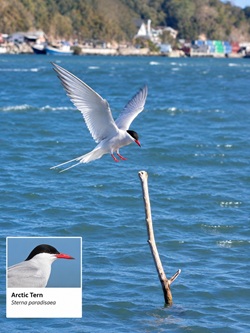
The Arctic Tern gets its scientific name Sterna
paradisaea. The species name means “of paradise.” The bird has a slim body,
long pointed wings, and a deeply forked tail.
Adult Arctic Terns have a light gray body and white head. At
a distance, they appear strikingly white. Their bills are red, with a darker
tip. Their legs and feet are also red. During flight, the long, pointed wings
and deeply forked tail make the bird easy to recognize.
The Arctic Tern is a relatively small seabird. It is built
for long-distance flight rather than for spending much time on land. Its long
wings allow it to travel enormous distances while using wind and air currents
efficiently.
A Sign of Gorontalo’s Changing Seasons
The arrival of the Arctic Tern is interesting for another
reason. It provides a seasonal marker for the Gorontalo diving community. Our
dive center and dock are located at the estuary of Bone (BOH-nay) River where these
terns rest. Their arrival indicates that seasons are changing here.
Arrival in September means the fierce east winds will soon
give way to gentler west winds. However, their arrival in May means that
winds will soon reverse to the east, generating high waves. Miguel’s Diving
only operates during west wind season. This is November to April.
Hunting on the Wing
Arctic Terns eat small fish and other prey. This includes
small crustaceans, marine worms, and even flying insects. Since the Bone River
estuary is quite shallow, it provides them with a feeding ground.
Seasonally, we see them flying low over the estuary. They may be hunting for a
quick meal during their temporary stopover in Gorontalo.
If you visit Miguel’s Diving during the season, keep looking
beyond the reef. Some of the most interesting wildlife can be found above the
water as well as below it. For dive bookings, please contact us.